π·οΈ Have a coupon code?
Make your self-industry ready, just degree is not enough space in industry
Created by Mr. Nilesh S .Wagh Β· Last updated May 2026
π·οΈ Have a coupon code?
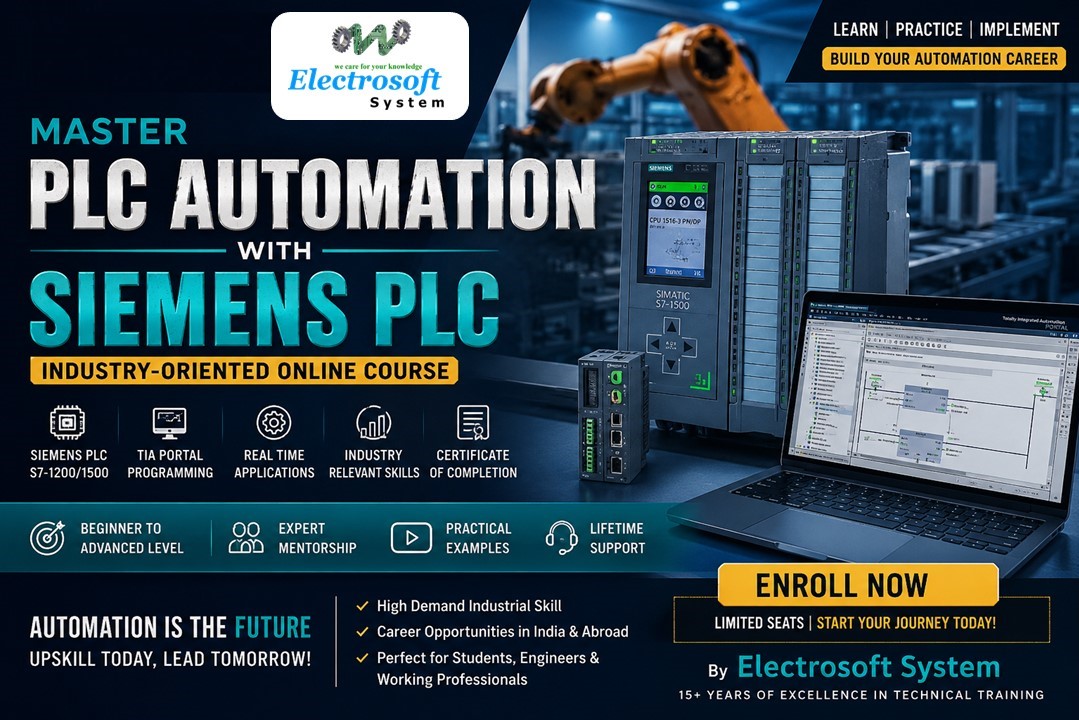
Module 1: Industrial Automation & PLC Foundations
β’ Basics of Industrial Automation
β’ Fundamentals of PLC β’ Types of PLC and its Applications
β’ Input and Output of PLC β’ Basic Automation & Relay Logic
Module 2: Siemens TIA Portal Software & Simulation
β’ Siemens TIA Portal Environment Setup
β’ Simulation of TIA Portal & Communications Module
3: PLC Programming, Hardware, & Implementation
β’ Programming in TIA Portal & Hardware Interfacing
β’ Introduction of Blocks and Bit Logic
β’ Practical Tasks & Application Scenarios
12th+
Willing to work on Industry ready course Hardware Specifications (PC/Laptop)
Software Requirements
Why This Curriculum Guarantees Job Readiness
1. The "Relay to PLC" Bridge Most beginners fail because they don't understand the physical "why" behind the code. By starting with Relays and Switchgear, you learn the fundamental electrical safety and logic that prevents expensive hardware damage on the job. You aren't just a coder; you are an engineer who understands the Electromagnetic Switch logic.
2. Mastery of the Industry Standard: Siemens TIA Portal Siemens is the "operating system" of the industrial world, especially in power plants and large-scale manufacturing. Physical Interfacing: Learning Source/Sink wiring is the #1 skill required during industrial site visits. Communication: Mastering Ethernet (PROFINET) communication makes you ready for the "Connected Factory" (Industry 4.0).
3. Real-World Logic (Latching & Interlocking) The "Tasks" section (Motor ON/OFF, Interlocking) represents 80% of the actual logic used in factories. Understanding Interlocks is critical for industrial safety; a job candidate who can explain how to prevent two motors from running simultaneously to avoid a short circuit is an immediate hire.
4. Sector-Specific Training By covering Batch Production and Power Plant Automation, you aren't limited to one industry. You become eligible for roles in: FMCG & Pharma (Batch Processing) Energy Sector (Power Plants) Agro-Industries (Farm Automation β a growing niche in Maharashtra) Career Roles You Can Apply For: PLC Programmer: Writing and optimizing TIA Portal logic. Automation Maintenance Engineer: Troubleshooting existing factory lines. Control Panel Designer: Planning the physical wiring and switchgear layout. Application Engineer: Designing custom automation solutions for clients like the DIC or local polytechnics. The "Expert" Verdict This syllabus doesn't just teach you how to "click buttons" in a software; it teaches you how the machine thinks. In an interview, when you can explain the difference between a Modular PLC and a Compact PLC while demonstrating Source/Sink wiring, you move from being a "fresher" to a "technical professional."
Expert Instructor Β· Industrial Automation
Mr. Nilesh S .Wagh is an experienced instructor with deep expertise in Industrial Automation. With a focus on practical, real-world learning, the teaching approach ensures students gain skills they can apply immediately in their careers or projects. Committed to helping every student succeed regardless of their background or experience level.
Excellent teaching, practical knowledge, very helpful.
The PLC automation classes are really easy to understand. The teaching is simple, so itβs good for beginners. Sir adjusts the speed according to us, so we donβt feel rushed. Basic concepts are explained clearly, which makes learning easier. Also, doubts are cleared properly whenever we ask.
The PLC automation classes are very useful and easy to understand. The teaching method is flexible and adapts to student needs. Concepts are explained clearly with practical examples, which helps in better understanding. Overall, it is a good learning experience.
I have learned this course well, but I feel that some concession should be given in the fees. This is a humble request to sir.
PLC course I have learned is very helpful also I have learned much more practical skills.
Delta PLC course is good for beginners in industrial automation. It teaches ladder logic, timers, counters, motor control, and practical applications using WPLSoft. It is affordable and useful for job opportunities in industries. However, the software is a little old and less advanced than Siemens PLC. Overall, it is a very good course for basic to intermediate PLC learning and big thanks to wagh sir as guidance
βExcellent PLC class with practical examples and easy-to-understand teaching.β
I have learned this course well, but I feel that some concession should be given in the fees. This is a humble request to sir.
βExcellent PLC class with practical examples and easy-to-understand teaching.β
Share your experience to help other students make the right choice.