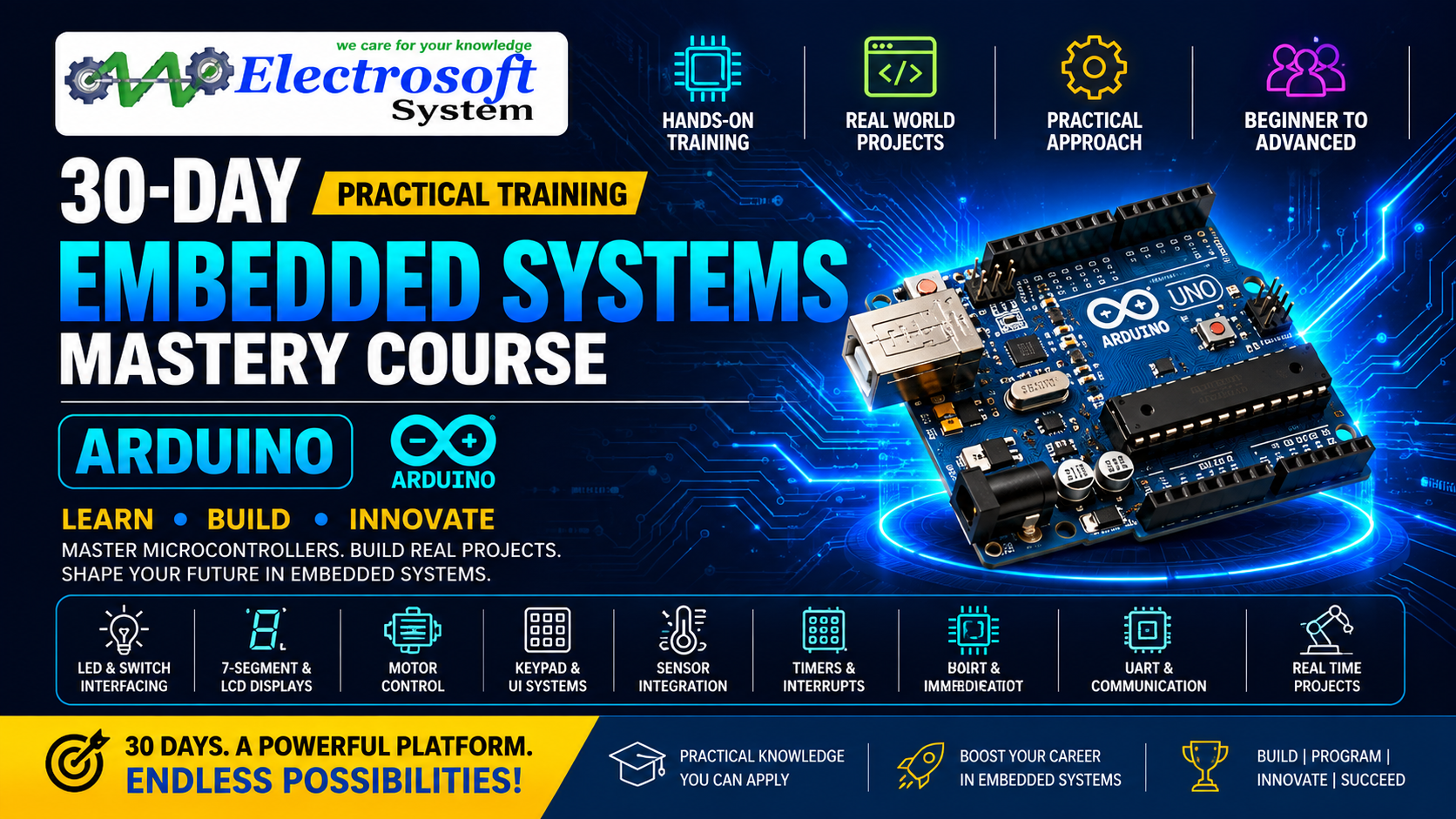
The 30-Day Embedded Systems Mastery Course is an industry-oriented practical training program focused on developing strong embedded systems and microcontroller programming skills using both Arduino and 8051 platforms. The course is divided into two major sections: the first 15 days focus on Arduino programming and interfacing, while the remaining 15 days focus on 8051 microcontroller architecture and embedded application development.
The training begins with the fundamentals of microcontrollers, embedded system architecture, GPIO interfacing, digital electronics, and development environment setup. Students gradually learn how to interface LEDs, switches, push buttons, 7-segment displays, LCD displays, motors, sensors, keypads, and communication modules using real-time hardware programming techniques.
The Arduino section focuses on rapid prototyping, beginner-friendly programming, sensor interfacing, motor control, and system integration. Students learn how to build automation systems, display systems, user interfaces, and smart embedded applications using practical projects.
The 8051 section introduces students to low-level embedded programming concepts including Special Function Registers (SFRs), timers, interrupts, UART communication, ADC interfacing, and memory optimization. Students gain deep understanding of microcontroller internals and real-time embedded system design.
The course emphasizes hands-on learning through practical experiments, mini-projects, debugging sessions, hardware integration, and complete system development. By the end of the course, students will be capable of designing and developing embedded systems for automation, robotics, IoT, industrial control, and smart electronic applications.
This course is suitable for:
Diploma Students
Engineering Students
Electronics Beginners
Robotics Enthusiasts
IoT Learners
Automation Students
Embedded System Beginners
Hobbyists & Innovators
This training builds a strong foundation for advanced learning in:
Embedded Systems
Robotics
IoT
Industrial Automation
PCB Design
RTOS
Smart Electronics
AI Hardware Systems